KONNI, Blockchain Lures, and the Developer as a Phishing Target
January 2026 reporting on a KONNI-linked campaign showed a phishing chain aimed at developers and engineering teams, using project documents, Discord-hosted ZIP files, LNK execution, and an AI-written PowerShell backdoor.
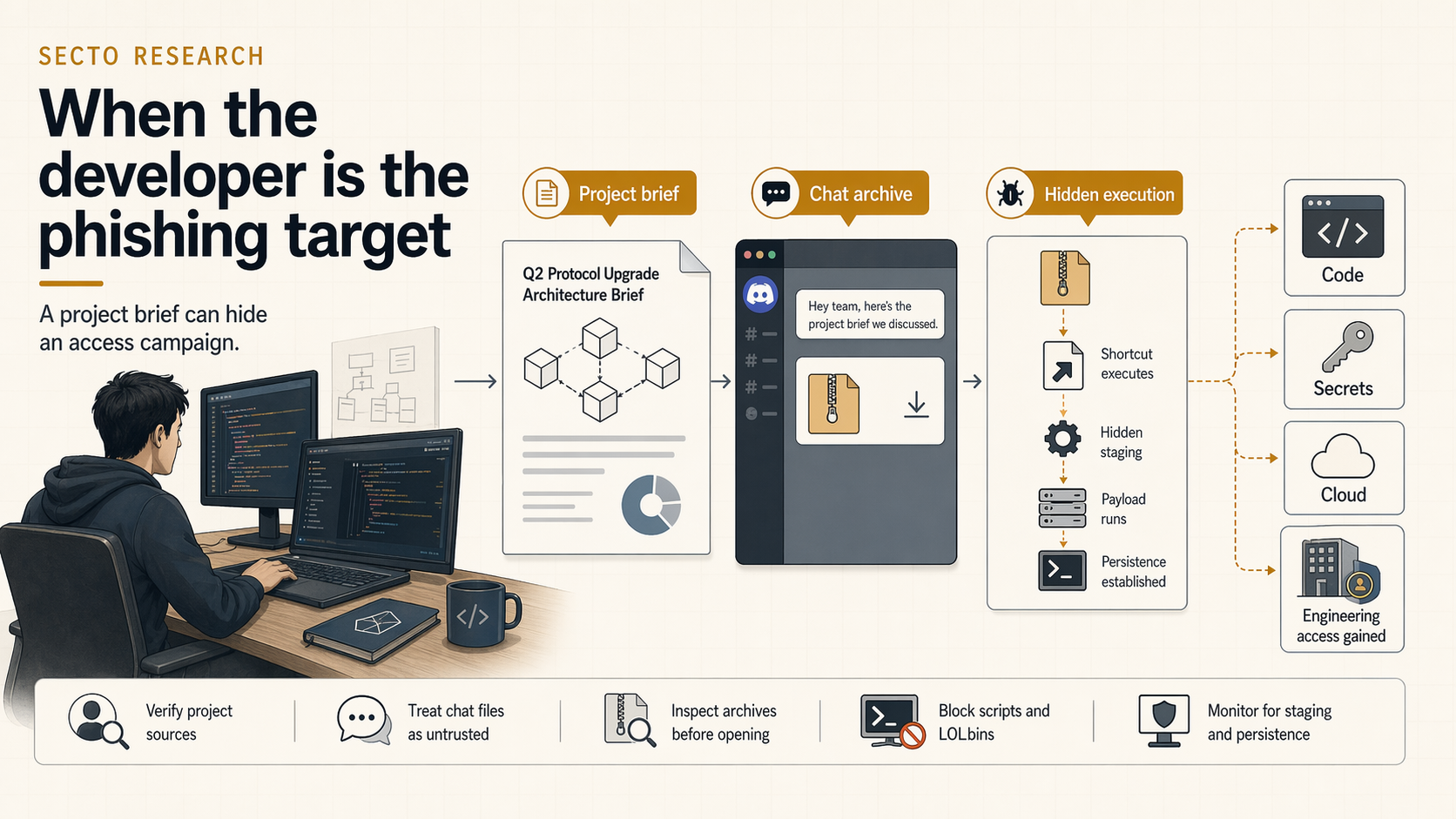
Developers and engineering teams can be high-value phishing targets because they often sit close to systems and credentials that are difficult to recover once exposed.
Public January 22, 2026 reporting described a campaign linked to KONNI that targeted software developers and engineering teams with blockchain-themed project materials. The documents looked like normal work: architecture notes, timelines, technical plans, budgets. The delivery chain behind them did not technical report.
Developer-focused phishing changes the prize. Instead of a single mailbox, the attacker can end up near build systems, API credentials, wallets, repositories, and other engineering access paths that are materially harder to recover from once exposed.
Why Developers Are Worth Phishing
Developers sit close to high-value systems. A compromised engineering workstation can expose secrets managers, CI pipelines, cloud accounts, private repositories, package-signing paths, and communication channels used for incident response. In blockchain-adjacent environments, it can get even worse: wallet tooling, custody workflows, infrastructure keys, and deployment access may all converge around a small group of technical staff.
What makes this campaign stand out is the pretext. The phishing lure is not pretending to be payroll. It is pretending to be work the target would normally review as part of the job.
What The User Sees And What Executes
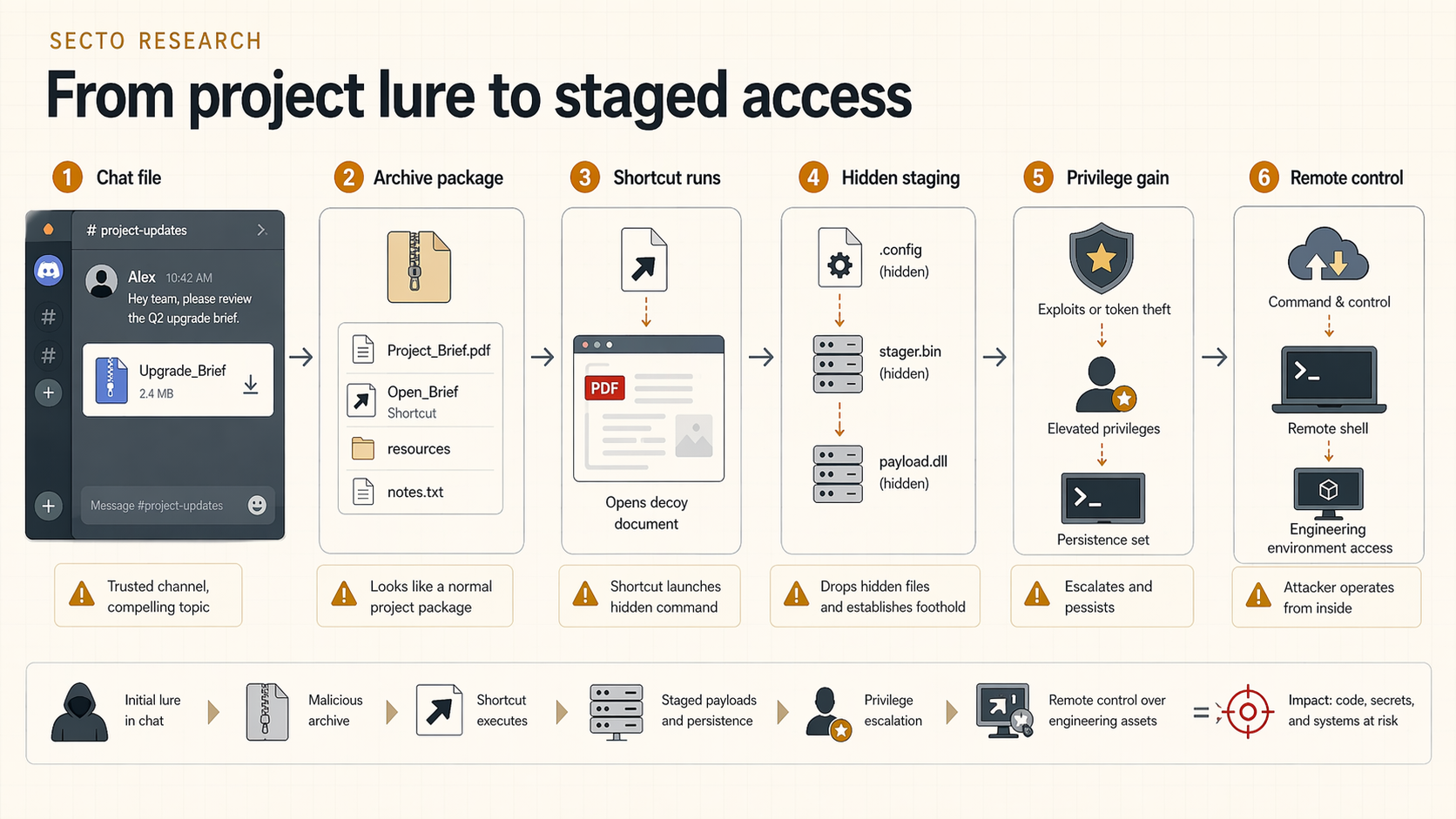
The observed chain began with a Discord-hosted ZIP archive. Inside were two files: a lure document and a Windows shortcut. When the shortcut executed, it opened a decoy document to keep the victim oriented while unpacking a second stage that included batch scripts, a PowerShell backdoor, and tooling for privilege escalation.
The pattern is familiar. The phish does not need to look unusual after the first click. It only needs to keep the target focused on a plausible document while the second stage begins underneath.
Why The AI Detail Matters
The January reporting linked the campaign to an AI-generated PowerShell backdoor. That detail is interesting, but the larger operational point is not that AI wrote some code. It is that AI can reduce the cost of building and iterating the malware wrapped around a phishing workflow.
In the observed chain, the backdoor handled staging, host identification, privilege-aware execution, command polling, and post-exploitation setup. The campaign also used a UAC bypass path and, in some execution states, deployed legitimate remote-management software for longer-term access. This is not a simple credential-harvesting phish. It is an access campaign that uses phishing as the entry point.
A more useful conclusion is that phishing crews may be able to speed up the engineering around persistence and remote control when that tooling is easy to generate and adapt.
What Makes This Different From A Standard Document Lure
- The lure matches the target's real work. Technical project artifacts are easier to trust when the recipient actually handles them.
- The delivery path blends into developer habits. ZIP archives, chat-delivered files, shortcut execution, and staging scripts are not random choices.
- The post-compromise goals are broader. The attacker wants the environment around the developer, not only the initial machine.
- The chain is built for follow-on control. Privilege escalation, scheduled execution, and remote-management tooling turn phishing into durable access.
Where Browser Defense Fits, And Where It Does Not
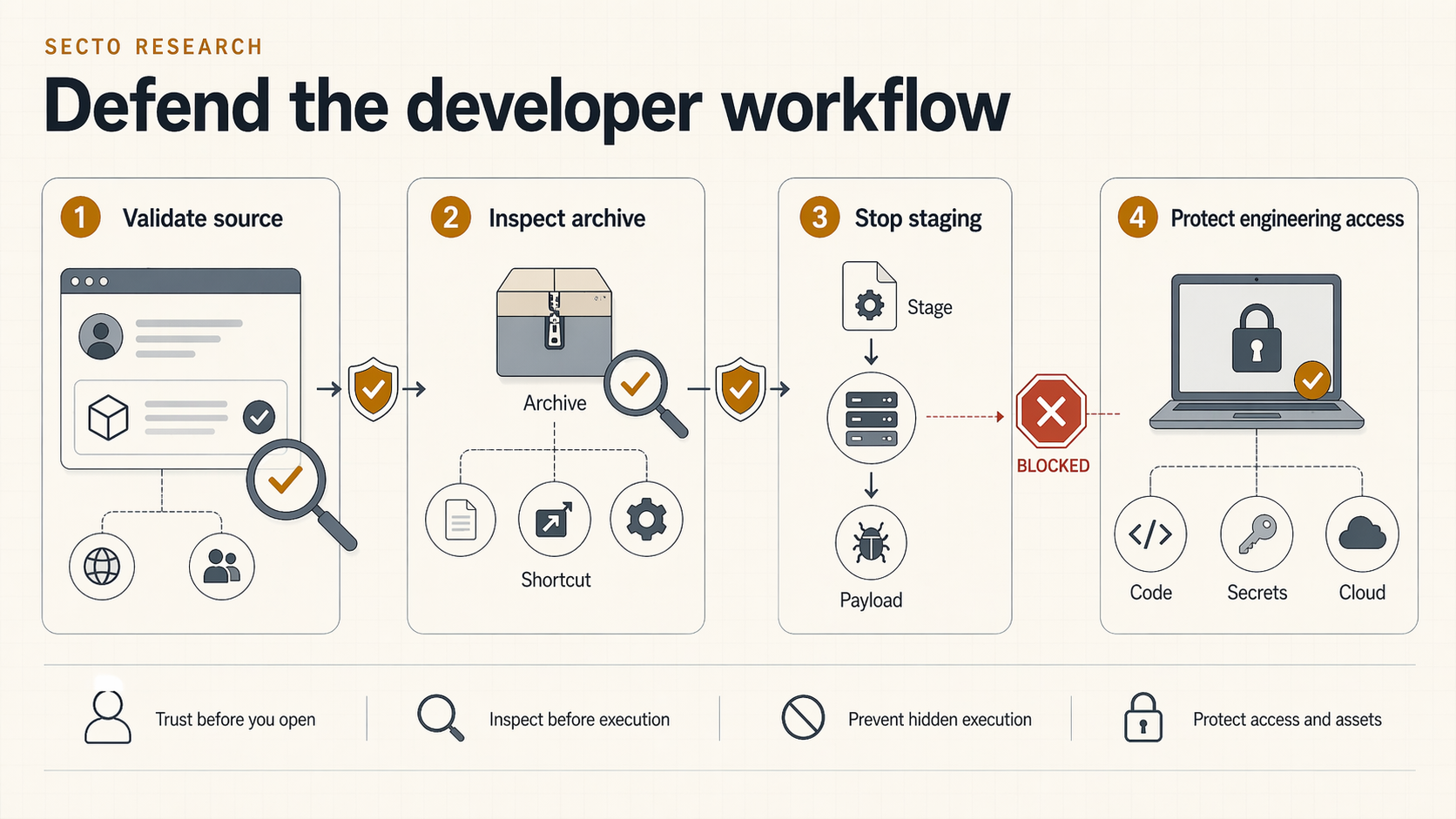
This is not mainly a browser story. It is first an endpoint and execution story, which means archive inspection, shortcut controls, script blocking, privilege boundaries, and engineering hardening carry more weight than URL filtering alone.
Secto has a narrower role here. If the lure includes a browser-hosted project portal, a fake sign-in checkpoint, or a download handoff wrapped in a convincing web page, browser inspection can still help before the user trusts the wrong destination.
But for the chain described in the January reporting, the larger defensive burden sits with host, identity, and engineering-environment controls. Saying that plainly makes the rest of the analysis stronger.